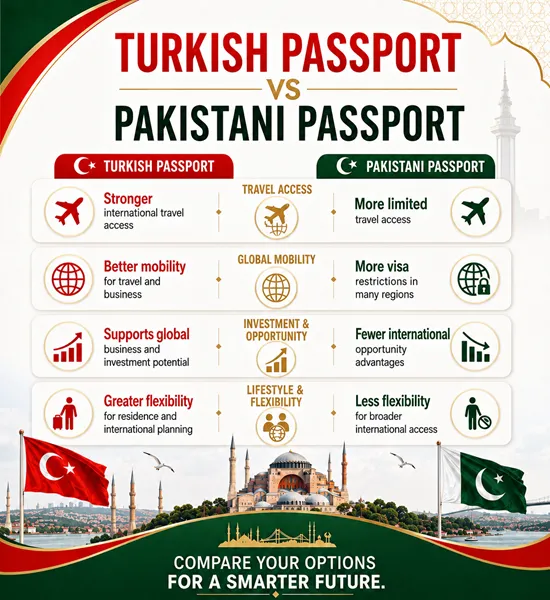
Turkish Passport vs Pakistani Passport at a Glance
This comparison focuses on the issues that matter most to Pakistani applicants: citizenship rights, international travel, Schengen access, passport validity and the possible effect of acquiring Turkish citizenship on Pakistani nationality documents.
| Comparison Area |
Turkish Passport |
Pakistani Passport |
| Citizenship base |
Confirms Turkish citizenship and permanent rights in Türkiye |
Confirms Pakistani citizenship and permanent rights in Pakistan |
| Short-visit mobility |
Generally offers wider visa-free, visa-on-arrival and electronic access |
Advance visas are required for a larger number of destinations |
| Schengen travel |
An ordinary passport generally requires a Schengen visa |
An ordinary passport generally requires a Schengen visa |
| Living and working in Türkiye |
Citizen rights apply without a foreign residence or work permit |
Requires the appropriate Turkish immigration or work authorization |
| Living and working in Pakistan |
Depends on the holder's lawful Pakistani nationality or immigration status |
Citizen rights apply without foreign immigration permission |
| Ordinary passport validity |
Available for periods up to ten years under current Turkish rules |
Five- or ten-year validity is available to eligible applicants; children under fifteen receive up to five years |
| Dual-nationality concern |
Türkiye has procedures for recording multiple citizenship |
Retention of Pakistani citizenship depends on Pakistani law and the applicant's circumstances |
1. The Most Important Difference Is Citizenship Rights
A passport is more than a travel document. It is evidence of nationality. A Turkish passport connects its holder to permanent citizenship rights in Türkiye, while a Pakistani passport connects its holder to permanent citizenship rights in Pakistan.
This distinction matters more than passport colour or a commercial ranking. A Turkish citizen can build a permanent life in Türkiye without renewing a foreign residence permit. A Pakistani citizen has the corresponding home-country rights in Pakistan. Travel access to third countries is an additional benefit, not the complete value of either passport.
2. Which Passport Is Better for International Travel?
For general tourism and short business visits, the Turkish ordinary passport normally provides broader access. Depending on the destination, entry may be visa-free, visa on arrival, an e-visa or an electronic travel authorization.
A Pakistani ordinary passport usually requires advance visas for more destinations. Even where a Turkish passport has easier access, travellers may still need sufficient passport validity, accommodation details, a return ticket, insurance or proof of funds. The current rule for each journey should be checked through official government sources.
For destination-specific information, review the separate guide to visa-free countries for the Turkish passport.
3. Schengen and European Union Rights
Neither ordinary Turkish nor ordinary Pakistani passport generally provides visa-free short-stay access to the Schengen area. Both holders normally need a Schengen visa unless a separate exemption applies.
Turkish citizenship is also not European Union citizenship. It does not automatically give the right to live, work or study in Germany, France, Italy, Spain or another EU country. Long-term residence requires the appropriate national route, such as employment, education, family reunification or another qualifying permit.
4. United Kingdom, United States and Canada
Ordinary Turkish and Pakistani passport holders generally need advance visas for the United Kingdom, United States and Canada. A Turkish passport may change the travel profile presented in an individual application, but it does not guarantee approval.
Visa decisions usually depend on the complete case, including travel purpose, finances, employment, family ties, previous travel and immigration compliance. Turkish citizenship should therefore not be purchased on the promise of guaranteed access to these countries.
5. Living and Working in Türkiye
A Turkish passport confirms the right to live in Türkiye as a citizen. The holder does not depend on a foreign residence permit for continued stay and normally works under citizen rules, although regulated professions may still require licensing, qualification recognition or language competence.
A Pakistani passport alone does not create these rights. A Pakistani national generally needs the relevant visa, residence permit or work authorization unless Turkish citizenship is acquired through a lawful route.
Applicants considering investment can first review Turkish citizenship by investment for Pakistanis and the current citizenship requirements.
6. Travelling Between Pakistan and Türkiye
A Turkish citizen enters Türkiye as a national. An ordinary Pakistani passport holder generally requires a Turkish visa. Eligible Pakistani applicants holding specified supporting visas or residence permits may qualify for a conditional Turkish e-visa, but all current requirements must be satisfied before travel.
A Pakistani citizen enters Pakistan using valid Pakistani nationality documents. A person travelling only on a Turkish passport is treated according to Pakistan's rules for Turkish nationals unless Pakistani citizenship or another qualifying status is also lawfully retained and documented.
7. Passport Validity and Renewal
Türkiye issues ordinary burgundy passports for different periods, including a ten-year option under current rules. Pakistan issues ordinary passports with five- or ten-year validity to eligible applicants. Pakistan's DGI&P states that children under fifteen receive a maximum five-year passport.
Passport validity does not by itself guarantee entry. A destination may require three or six months of remaining validity, blank pages or other conditions. Renewal procedures are handled through the relevant passport authority or diplomatic mission when the holder is abroad.
8. Dual Nationality Is the Key Legal Question for Pakistanis
Pakistan's official dual-nationality page currently lists 22 arrangement countries, and Türkiye is not included. Pakistani applicants should therefore not rely on a salesperson's statement that both passports can always be kept without consequences.
The correct position may depend on the applicant's personal circumstances, family status and the current interpretation of Pakistani citizenship law. Before applying, obtain written guidance on the effect on the Pakistani passport, CNIC or NICOP, property, inheritance, employment and future entry rights.
Questions to Confirm Before Applying
- Can Pakistani citizenship lawfully be retained after acquiring Turkish citizenship?
- Will the applicant's Pakistani passport and identity documents remain valid?
- Does the position differ for a spouse or minor child?
- Is any declaration, registration or renunciation procedure required?
- How could the decision affect property, inheritance or employment in Pakistan?
9. Family and Children's Position
Every family member needs their own lawful citizenship status and travel document. A parent's passport does not replace a child's passport. Birth records, custody documents, consent letters and identity details should remain consistent across both countries' records.
Under a qualifying Turkish citizenship route, a spouse and eligible minor children may be included subject to the applicable rules. Adult children, parents and extended family members are not automatically included. Family eligibility should be confirmed before funds are committed.
10. Property Does Not Automatically Produce a Passport
Eligible Pakistani nationals may purchase property in Türkiye subject to current legal restrictions and due diligence. Property ownership and Turkish citizenship are separate legal matters. A passport becomes available only after a qualifying citizenship application has been completed and approved.
Where property is being considered, study the requirements for property for Turkish citizenship. The property should also make commercial sense independently of the passport objective.
11. Which Passport Is More Relevant for Your Goal?
| Main Goal |
More Relevant Position |
What to Verify |
| Permanent life in Türkiye |
Turkish citizenship provides the direct legal base |
Application route, family inclusion and Pakistan nationality consequences |
| Permanent life in Pakistan |
Pakistani citizenship rights remain central |
Effect of any additional nationality on Pakistani documents and rights |
| Frequent international travel |
Turkish passport may provide wider short-visit mobility |
Rules for the countries actually visited |
| Living in the EU or UK |
Neither passport gives automatic residence rights |
A separate work, study, family or residence route |
| Family education in Türkiye |
Turkish citizenship may offer stronger long-term continuity |
Admission, language, tuition and each child's status |
| Citizenship through property |
The passport follows only after approved citizenship |
Property eligibility, valuation, payment and holding requirements |
12. Practical Checklist Before Making a Decision
- List the countries you actually need to visit.
- Separate visa-free entry from e-visas and visas on arrival.
- Identify where your family plans to live for the next five to ten years.
- Confirm the status of your Pakistani citizenship and identity documents in writing.
- Check spouse and child eligibility separately.
- Review the total citizenship and investment cost, not only the passport fee.
- Assess property or another investment on its own commercial merits.
- Use official sources rather than passport-index marketing claims.
Official Sources to Verify
Conclusion
The Turkish passport generally offers broader short-visit mobility and confirms permanent citizenship rights in Türkiye. The Pakistani passport remains essential for the citizenship rights, identity and unrestricted return associated with Pakistan.
For a Pakistani applicant, the best decision is not based only on which passport appears stronger. It depends on where the family will live, which destinations genuinely matter and whether Turkish citizenship can be acquired without creating an unresolved Pakistani nationality issue. Confirm that legal position first, then evaluate the travel, family and investment benefits.