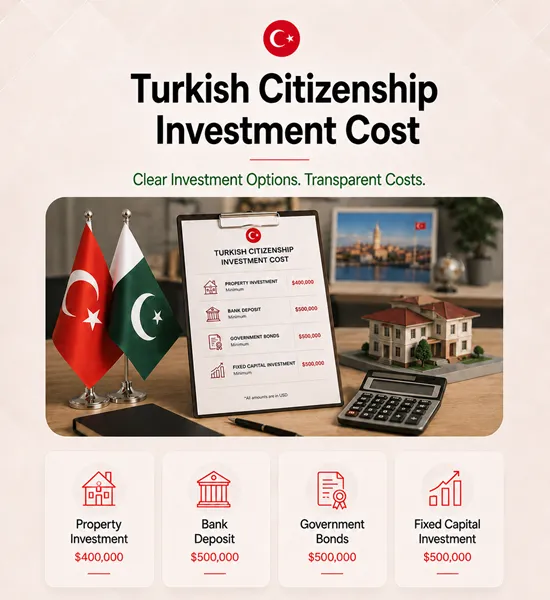
Turkish Citizenship Cost at a Glance
The final amount depends on the property, declared value, transaction structure, family size and professional services used. Some costs are fixed by law or annual tariff, while others are market-based and should be quoted in writing before payment.
| Budget Category |
How It Is Calculated |
Planning Note |
| Qualifying real estate |
At least USD 400,000 or equivalent foreign currency |
The official value, payment evidence and property eligibility must support the route |
| Title-deed fee |
Statutory buyer and seller shares are calculated on the declared sale value |
Confirm in the contract who will pay each share |
| Revolving-fund charge |
Land-registry service charge under the current annual tariff |
Amount changes by year and transaction |
| Valuation and citizenship-value records |
Based on the required appraisal and land-registry process |
Do not assume the sale price alone proves the citizenship value |
| Banking and foreign exchange |
Transfer, conversion and intermediary-bank charges |
Keep the payment trail consistent with the title transaction |
| Documents and family file |
Depends on applicants, translations, notarization and legalization |
More family members usually mean more document expense |
| Legal and professional services |
Private fee agreed with the service provider |
Request scope, exclusions and taxes in writing |
1. Minimum Property Investment
The property route currently requires real estate worth at least USD 400,000 or equivalent foreign currency, together with the required three-year restriction. Official Invest in Türkiye guidance also makes clear that citizenship remains subject to official confirmation and government decision.
Budgeting exactly USD 400,000 can be risky. The citizenship calculation depends on the qualifying official records, not only the advertised price or a private reservation agreement. A buyer should leave enough room for valuation differences, exchange-rate movement and properties that fail eligibility checks.
The distinction between the threshold and the wider route is explained in our minimum investment for Turkish citizenship guide.
2. Title-Deed Fee: Buyer Share and Contract Risk
Türkiye's Land Registry and Cadastre authority states that, for an ordinary sale, the buyer and seller are each charged 20 per thousand—2%—of the declared sale value, provided that value is not below the applicable property-tax value. A separate revolving-fund service charge also applies.
On a declared value equivalent to USD 400,000, the buyer's statutory 2% share would be equivalent to USD 8,000. The seller's statutory share would be another USD 8,000 equivalent. In practice, some contracts ask the buyer to cover both shares, which would make the title-deed fee exposure equivalent to 4% or USD 16,000 on the same base.
Check the current TKGM sale-fee guidance and write the allocation clearly in the purchase contract. The fee is paid in Turkish lira under the transaction rules, so the exact foreign-currency equivalent can change with the exchange rate.
| Example on USD 400,000 Equivalent |
Illustrative Amount |
Important Qualification |
| Buyer's statutory 2% share |
USD 8,000 equivalent |
Calculated and paid under the official TRY transaction value |
| Seller's statutory 2% share |
USD 8,000 equivalent |
The contract may shift this cost to the buyer |
| Possible buyer exposure if paying both |
USD 16,000 equivalent |
Confirm before reservation or deposit |
3. Valuation and Citizenship-Value Documentation
A citizenship property needs the required valuation and value-determination records. The official value, title-deed declaration and payment evidence must support the qualifying amount. An attractive invoice or developer list price does not replace the land-registry process.
The Your Key Türkiye official FAQ explains citizenship valuation, the appraisal request system, the value-determination certificate and foreign-exchange purchase documentation. It also notes that the relevant value certificate has a limited validity period, so timing matters.
Valuation charges are not a permanent USD figure. Request the current fee and confirm whether the quotation includes taxes, report handling and any repeat report needed because of expiry or a property change.
4. Revolving-Fund and Land-Registry Service Charges
In addition to the percentage title-deed fee, the land registry collects a revolving-fund service charge. The tariff is updated and can differ according to the transaction, location and whether a foreign party is involved.
Do not use an old article's lira amount as a permanent estimate. Ask for the current transaction calculation shortly before the title appointment and keep a small reserve for tariff changes, certified documents or additional land-registry requests.
5. Banking, DAB and Currency-Conversion Costs
Foreign buyers must structure the property payment through the required banking and foreign-exchange process. Bank transfer charges, SWIFT fees, intermediary-bank deductions and conversion spreads can reduce the amount that arrives or appears on the final record.
For citizenship, the payment receipt, foreign-exchange purchase certificate and official sale value should be coordinated before funds move. A shortfall created by bank fees or an incorrect payment reference can be more serious than the fee itself.
Banking Costs to Check in Advance
- Outgoing transfer fee charged by the Pakistani or overseas bank
- Correspondent and intermediary-bank deductions
- Turkish receiving-bank charges
- Foreign-exchange conversion spread
- Cost of correcting or reissuing banking documents
6. Pakistani Documents, Translation and Notarization
Pakistani applicants may need passports, birth or family records, marriage documents, custody evidence and other civil records. Expenses can include obtaining originals, certified copies, translation into Turkish, notarization and the applicable apostille or consular legalization route.
The cost rises when names, dates or relationships are inconsistent and documents must be corrected or reissued. Prepare the file before the property transaction and use the separate documents required for Turkish citizenship checklist.
7. Legal Review and Professional Service Fees
Legal due diligence, power-of-attorney preparation, contract review, title checks and citizenship-file services are private professional costs, not government fees. There is no universal official price for these services.
Ask for a written quotation showing what is included: property due diligence, title transfer attendance, valuation coordination, investment-conformity work, residence procedures, citizenship submission, family members, translations, tax and post-approval passport support.
Avoid Unclear Package Pricing
- Separate government charges from private professional fees.
- Check whether VAT or other taxes are included in the quotation.
- Confirm whether the price covers spouse and children.
- Ask who pays if a property fails the citizenship review.
- Do not accept a large unexplained “processing fee.”
8. Family Application Costs
The same qualifying investment may support the principal applicant's spouse and eligible children under the applicable route, but each additional applicant can create document, translation, photograph, notarization and application-handling costs.
Separated parents, previous marriages, custody issues and adult or dependent children can require additional records and professional review. Family eligibility should be checked before the service fee is agreed.
9. Ongoing Property Costs After Purchase
The citizenship application budget should be separated from the cost of owning the property for at least three years. The buyer may face annual property tax, compulsory earthquake insurance where applicable, building or site charges, utilities, repairs, property management and tax on rental income or sale.
A property can meet the citizenship threshold but still be expensive to hold. Review the wider cost of buying property in Turkey before comparing projects.
| Ongoing Cost |
Why It Matters |
| Annual property tax |
Recurring ownership obligation based on local rules |
| DASK and insurance |
Protection and transaction requirements may apply |
| Aidat or site fees |
Can materially affect apartment investment returns |
| Maintenance and management |
Important for owners living outside Türkiye |
| Rental and sale taxation |
Depends on income, holding period and tax position |
10. A Realistic Budget Framework
A safe budget should not assume that USD 400,000 covers the complete transaction. Build the plan in separate layers and do not transfer funds until the property and cost schedule have been reviewed.
- Qualifying property value with a reasonable margin above the minimum.
- Buyer's title-deed share and any seller share shifted by contract.
- Revolving-fund, valuation and land-registry expenses.
- Bank, SWIFT, DAB and foreign-exchange costs.
- Pakistani documents, translation, notarization and legalization.
- Legal due diligence and citizenship-file professional fees.
- Family-member expenses and travel where required.
- Three-year property holding and management reserve.
11. Common Cost Mistakes
- Budgeting exactly USD 400,000 with no valuation or exchange-rate margin
- Assuming the seller will pay their title-deed share
- Using an advertised property price as proof of citizenship value
- Ignoring bank deductions and currency-conversion spread
- Accepting commissions or service charges that are not itemized
- Forgetting spouse and children's document costs
- Confusing property purchase costs with citizenship application costs
- Ignoring aidat, tax, insurance and maintenance during the three-year hold
Property compliance matters as much as the budget. Review property for Turkish citizenship before paying a reservation amount.
12. Final Cost Checklist
| Property value |
Qualifying official value and payment records exceed the current minimum |
| Title-deed allocation |
Buyer and seller fee responsibility is written in the contract |
| Official charges |
Current valuation, land-registry and revolving-fund figures are confirmed |
| Banking |
Transfer deductions, DAB and conversion costs are included |
| Documents |
Pakistan-issued records, translations and legalization are budgeted |
| Professional fees |
Scope, family coverage, exclusions and taxes are written clearly |
| Holding costs |
Three-year tax, insurance, aidat and management reserve is available |
Conclusion
Turkish citizenship investment cost for Pakistanis is not limited to the USD 400,000 qualifying property. A realistic plan includes the title-deed fee, annual tariff-based land-registry charges, valuation, banking and currency conversion, Pakistani documents, family preparation, professional services and the cost of holding the property.
The safest approach is to request an itemized budget before reservation, verify the property and official value, and keep a margin for exchange-rate and document changes. After the budget is clear, review the expected Turkish citizenship processing timeline before starting the transaction.