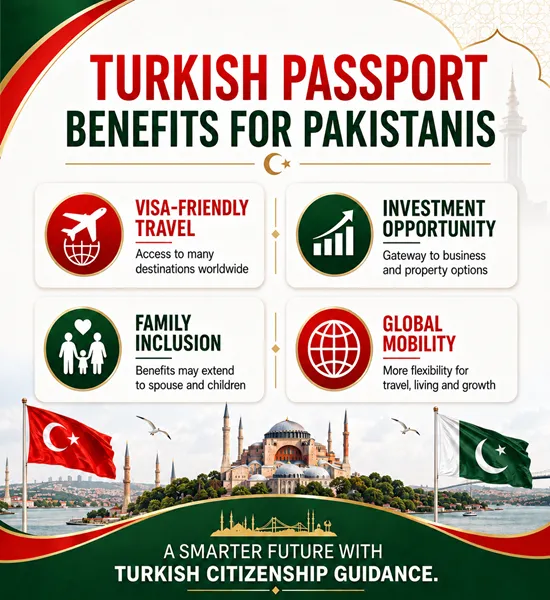
Turkish Passport Benefits at a Glance
The strongest benefits are connected to permanent citizenship rights in Türkiye. Travel access is useful, but residence security, family planning and the ability to build a long-term life may be more important for many Pakistani applicants.
| Benefit |
Practical Value |
Important Limit |
| Permanent residence in Türkiye |
Live in Türkiye without relying on foreign residence-permit renewals |
Citizenship must first be approved and registered |
| Work rights |
Ordinary employment does not depend on a foreign work permit |
Regulated professions may require licences or qualification recognition |
| International mobility |
Broader visa-free, visa-on-arrival and electronic-entry access |
Rules change and many major destinations still require visas |
| Family continuity |
A stable citizenship base for eligible family members |
Inclusion depends on the route, age, relationship and documents |
| Business and property planning |
Operate and invest as a citizen rather than as a temporary resident |
Tax, banking, licensing and due-diligence rules still apply |
| Turkish identity and consular support |
Access to Turkish identity records and diplomatic assistance abroad |
Eligibility rules apply and consular help cannot override foreign law |
1. Permanent Right to Live in Türkiye
A Turkish citizen does not need a short-term residence permit simply to remain in Türkiye. This provides greater stability than depending on a property, employment contract or temporary immigration category that may require repeated renewals.
For Pakistani families considering relocation, retirement or a second home, this can make long-term planning more predictable. Citizenship and a residence permit are not the same: a residence permit is temporary permission, while citizenship creates a permanent legal connection to the country.
2. Ability to Work Without a Foreign Work Permit
Turkish citizens work under the rules applicable to citizens rather than the foreign work-permit system. This can simplify employment, career changes, self-employment and day-to-day company management.
Citizenship does not remove professional requirements. Doctors, lawyers, engineers, teachers and other regulated professionals may still need Turkish-language ability, qualification recognition, registration or a sector-specific licence.
3. Broader International Travel Options
An ordinary Turkish passport generally offers broader short-visit mobility than a Pakistani passport. Depending on the destination, entry may be visa-free, available on arrival or subject to an electronic authorization. For destination examples and current travel categories, review the detailed visa-free countries for Turkish passport guide.
The official Republic of Türkiye Ministry of Foreign Affairs should be checked before each trip. Passport validity, stay limits, return tickets, insurance, electronic forms and transit rules can change without notice.
Travel Access Is Not Unlimited
- Visa-free entry normally covers short visits, not employment or permanent residence.
- Schengen countries generally still require a visa for ordinary Turkish passport holders.
- The United Kingdom, United States and Canada generally require advance visas.
- Border officers can still request funds, accommodation and onward-travel evidence.
4. A Permanent Home-Country Base
A Turkish citizen can return to Türkiye as a national rather than as a visitor. This may be useful during employment changes, family transitions, retirement planning or regional uncertainty because the right to enter and remain does not depend on a temporary foreigner status.
This benefit is most meaningful when the applicant genuinely intends to use Türkiye as a home, business base or long-term family location. A passport obtained only for marketing claims may provide less practical value than expected.
5. Family Stability and Future Planning
Under qualifying citizenship routes, a spouse and eligible minor children may be included subject to the route, family documents, custody position and official approval. Adult children, parents and siblings are not automatically included.
Citizenship may also support continuity for future children through Turkish nationality rules, provided births, marriages and civil-status changes are registered correctly. Families should confirm inclusion before transferring investment funds or signing property documents.
6. Education and Healthcare Planning
Citizenship can make school and university planning more stable because the family is not relying on a temporary immigration status to remain in Türkiye. Admission, language, tuition, examinations and scholarship rules still apply separately.
A Turkish passport alone does not automatically create full public healthcare coverage. Access can depend on employment, social-security registration, contributions, family dependency or another legal basis. Citizenship, public insurance and private insurance should be treated as separate issues.
7. Business and Property Advantages
Citizenship can provide a more stable foundation for entrepreneurs who want to operate in Türkiye over the long term. A citizen can manage ordinary commercial activity without depending on residence status for personal presence, although company registration, taxes, banking checks and sector licences remain necessary.
Future property transactions are generally handled as citizen transactions rather than foreign acquisitions. This does not make every property safe or profitable. Legal title, valuation, zoning, debt, technical condition and rental calculations must still be checked independently.
Applicants using real estate as the citizenship route should first review property for Turkish citizenship. Official Invest in Türkiye guidance currently states that the qualifying property route requires at least USD 400,000 and a restriction against sale for three years, together with the required official confirmation.
8. Turkish Identity, Passport and Consular Support
After citizenship and civil registration are completed, a citizen receives access to Turkish identity documentation and may apply for an ordinary passport through the applicable process. The identity card is used for domestic identification, while the passport is mainly used for international travel.
The official Türkiye NVI passport guidance should be used for current application documents and procedures. Turkish citizens abroad may also seek consular help for lost passports, civil documents and emergencies, but consular assistance cannot override another country's laws.
9. Important Limits of a Turkish Passport
| Common Claim |
Correct Position |
| “A Turkish passport gives EU residence” |
No. Türkiye is not an EU member state |
| “Schengen travel is visa-free” |
Ordinary Turkish passport holders generally require a Schengen visa |
| “Property purchase automatically gives a passport” |
No. Citizenship approval and registration come before the passport |
| “All family members are included” |
Adult children and extended family normally need a separate basis |
| “A Turkish passport guarantees UK, US or Canadian visas” |
No. Each visa application is assessed independently |
10. Pakistan Dual-Nationality Issue
This is one of the most important questions for a Pakistani applicant. Türkiye has administrative procedures relating to multiple citizenship, but Pakistan's current official dual-nationality arrangement list contains 22 countries and does not include Türkiye.
Applicants should check the current Pakistan DGI&P dual-nationality guidance and obtain case-specific written advice from the competent Pakistani authority or mission. Do not assume that a Pakistani passport, CNIC or NICOP will automatically remain unaffected.
Questions to Confirm Before Applying
- Can Pakistani citizenship be retained after Turkish citizenship is acquired?
- What happens to the Pakistani passport, CNIC or NICOP?
- Does the position differ for a spouse or minor child?
- Could nationality status affect property, inheritance or public employment?
- Is any declaration, registration or renunciation procedure required?
11. Citizenship Comes Before the Passport
Buying property or meeting an investment threshold does not immediately issue a passport. The applicant must satisfy the chosen citizenship route, complete identity and security checks, receive the citizenship decision and finish Turkish civil-registration procedures.
Only after these steps can the new citizen apply for Turkish identity and passport documents. Review the complete Turkish citizenship by investment for Pakistanis guide before choosing an investment or preparing family documents.
12. Is a Turkish Passport Right for You?
A Turkish passport may be worth considering when the family plans to live, work, study, retire or operate a business in Türkiye, and when the applicant's real travel routes benefit from Turkish passport access.
It may be less suitable when the only objective is visa-free Schengen, UK, US or Canadian travel, when the investment creates excessive financial risk, or when the Pakistani nationality position has not been clarified.
| Residence Goal |
Confirm that Türkiye will be a genuine long-term base |
| Family |
Check exactly which family members can be included |
| Travel |
Compare actual destinations rather than passport rankings |
| Investment |
Assess commercial value independently of citizenship marketing |
| Pakistan Nationality |
Obtain written advice before assuming both passports can be retained |
| Comparison |
Review the practical Turkish passport vs Pakistani passport differences |
Conclusion
The main Turkish passport benefits for Pakistanis are permanent citizenship rights in Türkiye, the ability to live and work as a citizen, a stable base for eligible family members, broader international mobility and a stronger foundation for long-term business or property planning.
The passport also has clear limits. It is not EU citizenship, it does not guarantee major-country visas, and it is issued only after citizenship approval. For Pakistani applicants, the nationality position between Pakistan and Türkiye should be verified before the investment or application is finalized.